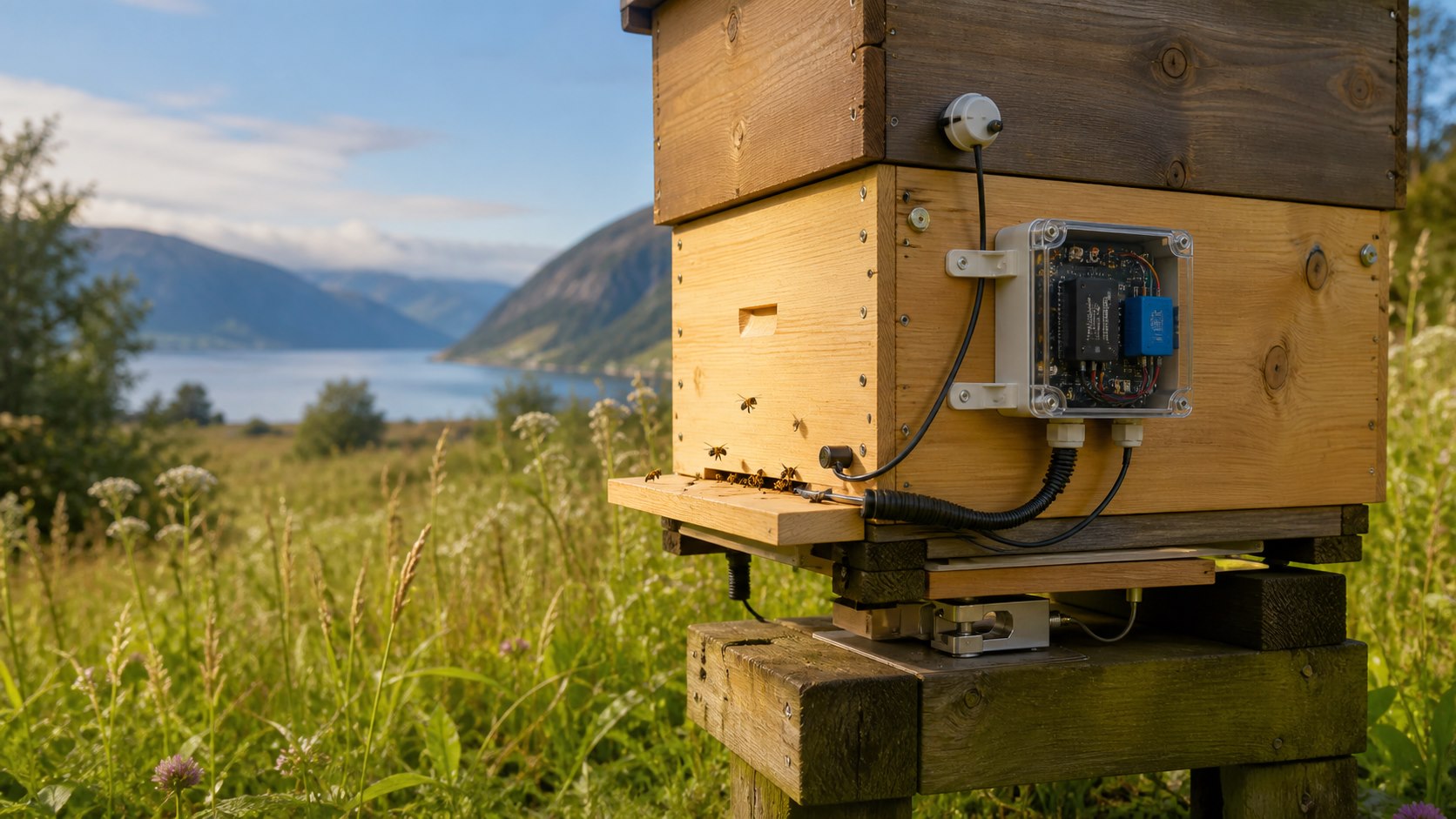
The system is built around an ESP32 microcontroller using mainly compact modular components. It monitors the environment inside and outside the hive, tracks hive weight and sends the measurements to a cloud backend for analysis and visualization.
Designed for real-world locations
Wi-Fi is the default communication mode. For remote locations, the unit can switch to NB-IoT or LTE-M mobile connectivity. It can also run from a battery when a fixed power line is unavailable.
The controller runs custom MicroPython firmware optimized for low-power data collection, timestamping and wireless transmission.
Sensor and module connections
Port 0
Environment inside the hive
Measures internal temperature, humidity, atmospheric pressure and volatile organic compounds.
Port 1
Weight
Connects to the load-sensor module and tracks changes in total hive weight over time.
Port 2
Environment outside
Measures outdoor carbon dioxide, temperature and humidity for comparison with conditions inside the hive.
Port 4
Mobile connectivity
An optional CAT-M module provides NB-IoT or LTE-M data connectivity when Wi-Fi is unavailable.
Port 5
Real-time clock
A dedicated RTC module provides precise timestamps for every measurement.
Data processing and control panel
Sensor readings are collected and transmitted to a cloud backend, where machine-learning models can identify trends, anomalies and patterns in hive activity.
The results are presented in a custom control panel with visual insight into hive health, environmental conditions and productivity over time. The same architecture can be adapted to other monitoring scenarios where sensors, connectivity, analysis and an operator interface need to work as one system.